For generations, American high schools have treated career planning as something that happens near the end of a student’s education. Students complete their required courses, meet with counselors, and consider what comes next. For those pursuing college, the process often begins years earlier, with academic schedules, standardized tests, and application deadlines shaping their choices.
Students interested in other pathways have not always received the same preparation.
Mike Feinberg, the education reformer who co-founded KIPP and later helped establish WorkTexas, believes that imbalance reflects a larger problem in how schools define success. Preparing young people for adulthood should involve more than encouraging them to pursue a four-year degree. It should also mean helping them understand the opportunities available in the workforce and the skills required to pursue them.
That does not mean asking teenagers to choose permanent careers before they graduate. It means giving them enough exposure to make informed decisions rather than expecting them to discover their options after leaving school.
For Feinberg, the distinction has become increasingly important as he considers what his decades in education have taught him about opportunity.
What Mike Feinberg Learned From the College-Preparation Era
When Feinberg co-founded KIPP in Houston in 1994, the organization’s mission challenged assumptions about what students from underserved communities could achieve. Its schools emphasized academic rigor, high expectations, and preparation for college.
The approach helped KIPP grow into a national network of more than 270 public charter schools. Feinberg’s early work, documented in a PBS profile of his involvement with KIPP, reflected a conviction that students deserved access to educational opportunities too often denied to them.
Over time, however, the outcomes of former students complicated the picture.
By the mid-2010s, more than half of KIPP Houston alumni were graduating from four-year colleges. It was a significant achievement, but Feinberg began asking what that statistic revealed about the other half.
Some alumni who had not completed college were building successful careers through military service, entrepreneurship, and skilled trades. Others had pursued degrees but accumulated substantial debt without finding the employment opportunities they expected.
The contrast led Feinberg to reconsider the assumption that college preparation should be synonymous with college attendance.
A school could maintain ambitious academic expectations while recognizing that students might pursue very different paths after graduation. In that framework, career counseling would become as important as college counseling, helping young people evaluate their interests, financial circumstances, and long-term goals.
Feinberg’s broader career in educational innovation, also reflected in his WISE education biography, provides context for that evolution. His central concern has remained educational opportunity, even as his understanding of how to create it has changed.
Why Students Need Exposure Before They Make a Choice
One weakness of the traditional college-centered model is that many students encounter skilled trades only after deciding that a four-year degree is not right for them.
By then, they may have spent years hearing that vocational education represents a fallback rather than a legitimate first choice.
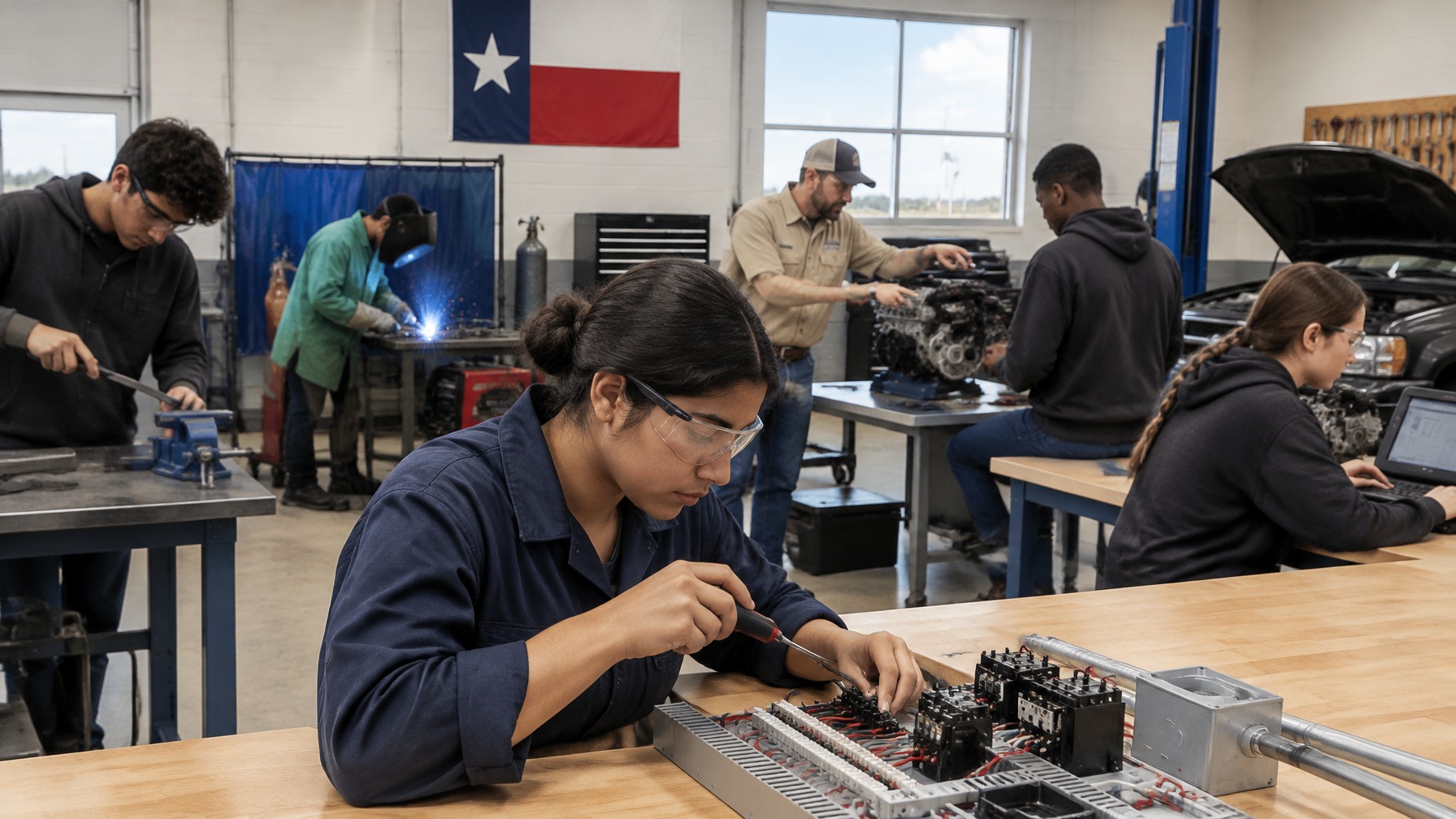
Earlier exposure could change that perception. Students who learn about electrical systems, HVAC technology, construction, healthcare support, or industrial maintenance can begin connecting academic subjects with practical applications.
Mathematics becomes more tangible when it is used to calculate measurements or electrical loads. Science takes on a different meaning when students see how heating and cooling systems operate. Communication and problem-solving become essential workplace skills rather than abstract classroom expectations.
Career exploration can also help students recognize that skilled work offers opportunities for advancement. An entry-level technician may eventually become a supervisor, specialize in a technical field, or establish a business.
These possibilities do not eliminate the value of college. They expand the range of futures students can reasonably imagine.
WorkTexas incorporates elements of that philosophy through its vocational training programs and partnerships with educational institutions. At its Houston campus inside Gallery Furniture, adult evening courses operate alongside a charter high school, creating an environment where academic education and practical career preparation coexist.
The organization’s Opportunity Center takes a related approach with justice-involved young people. Students divide their days between academic instruction and vocational training, rotating through different trades before selecting an area of concentration.
The structure gives participants an opportunity to explore careers while continuing their education, rather than treating the two pursuits as competing priorities.
A Broader Definition of College and Career Readiness
Feinberg’s approach raises questions that extend beyond any single training program.
If schools are serious about preparing students for adulthood, how should they measure readiness? College acceptance rates provide one answer, but they reveal little about whether graduates understand their career options or possess skills that employers value.
WorkTexas attempts to address that gap by involving employers in curriculum development and following graduates for at least five years after training.
The emphasis on long-term outcomes is particularly important. A student’s first job may be a starting point rather than a destination, and career success often depends on continued learning, reliable transportation, workplace relationships, and opportunities for advancement.
In his writing about the shift from diplomas to practical skills, Feinberg has explored the importance of connecting education more directly to employment.
There are limits to what schools can accomplish on their own. Labor markets change, employers’ needs evolve, and teenagers frequently discover new interests as they mature. Career education must leave room for those changes rather than narrowing students’ choices prematurely.
But exposing young people to multiple pathways can make those choices more meaningful.
The larger lesson from Feinberg’s work is not that every student should pursue a trade instead of college. It is that students deserve an education broad enough to prepare them for either possibility.
For schools, that requires moving beyond the question of where graduates will enroll next. The more consequential question is whether they leave with the knowledge, confidence, and options to build a future of their own choosing.